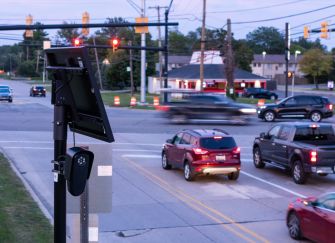
A Florida woman who spent 13 days in jail on eight felony charges after a Flock Safety license plate camera search led investigators to her SUV told senators Wednesday how she was wrongly accused of causing a crash that killed three people. Prosecutors later dropped the case against Lindsey Isaacs, 23, and charged another driver.
Isaacs, of Palm Coast, appeared before the Senate Judiciary Subcommittee on Crime and Counterterrorism during a hearing on Flock Safety and the growing use of automated license plate readers. She was arrested in April on charges that included three counts of vehicular homicide stemming from an October 2025 crash on Interstate 4 in Volusia County.
Investigators searching for a Dodge Durango involved in the deadly Oct. 4 crash turned to Flock’s network of license plate cameras. One camera recorded Isaacs’ black 2025 Durango traveling eastbound near the Seminole and Volusia county line at 9:51 p.m., about three miles west of the crash site. The collision occurred at approximately 9:53 p.m.
Her federal civil rights lawsuit alleges investigators omitted that timing from the affidavit used to obtain her arrest warrant.
The lawsuit also says a 911 caller reported a maroon Dodge Durango and supplied the first three characters of its license plate, “458.” Isaacs’ black Durango carried a different plate. Her complaint alleges that information was also left out of the warrant application.
Troopers arrived at Isaacs’ home hours after the crash and seized her SUV. In her Senate testimony, Isaacs said she provided a receipt and information showing where she had been and told investigators she had not been involved in a collision. Her vehicle remained in Florida Highway Patrol custody for more than six months.
An arrest warrant was obtained in April based in part on descriptions of scrapes, scuffs and other marks that investigators said were consistent with the collision. Isaacs surrendered April 17 and was booked into the Volusia County jail on eight felony charges. She spent about three and a half days in solitary confinement before being transferred to a maximum-security housing unit.
A judge denied bond on April 22. Days later, defense attorney Patrick McGeehan presented photographs of the Durango sitting in the FHP impound lot that he said showed the vehicle without the collision damage investigators had described.
The evidence prompted Assistant State Attorney Mike Willard to request help from FHP’s Specialized Investigation and Reconstruction Team. The team examined Isaacs’ Durango and found no damage suggesting that it had struck another vehicle. Investigators also identified red or maroon paint transfer on the Ford Focus involved in the crash and developed evidence pointing to a maroon Durango.
Isaacs was granted bond April 29 after 13 days in custody. On May 22, prosecutors filed a No Information, declining to pursue all eight charges against her.
Later that day, Alisa Lee Montalvo was arrested and charged with nine felonies arising from the same crash, including vehicular homicide and tampering with evidence. She has pleaded not guilty.
Isaacs filed her federal lawsuit in June against FHP Sgts. Tiffany Jateff and Joshua Buday in the U.S. District Court for the Middle District of Florida. The complaint accuses them of false arrest, wrongful imprisonment, and malicious prosecution and alleges that false descriptions of vehicle damage and omitted evidence affected the probable cause determination that led to her arrest and detention. The case remains pending.
Flock cameras can give police a time, location, and vehicle match, but that information still has to be tested against other evidence before investigators can tie a driver to a crime. Isaacs argues that the camera record, the maroon Durango report, the partial plate and the condition of her SUV all pointed away from her involvement.
Flock Safety has disputed claims that its technology caused Isaacs’ arrest. The company has said its cameras provide investigative leads and that the data in Isaacs’ case accurately recorded her vehicle several miles from the crash. Her own lawsuit characterizes that record as evidence pointing away from her involvement. Isaacs is suing the two troopers rather than Flock.
Senators also questioned witnesses about the scale, security and law enforcement use of automated license plate databases. Flock CEO Garrett Langley and the chief executives of Axon Enterprise, Motorola Solutions and Verkada were invited to testify but declined to appear. The committee instead heard from Isaacs, privacy advocates, a sheriff and cybersecurity engineer Benn Jordan.
Jordan told senators he had worked with researcher Jon Gaines, who identified and published 55 security vulnerabilities related to Flock. His testimony described weaknesses involving camera access, stored data and administrative systems, while also saying Flock had recently begun taking security more seriously.
Automated license plate readers photograph passing vehicles and create searchable records tied to a location and time. Their growing use has raised legal questions about how much historical vehicle-location data police can search and what safeguards govern access to large privately operated camera networks.
Isaacs closed her testimony by returning to the Flock record that became part of the investigation against her.
“That piece of information became part of an investigation that ultimately led to my arrest,” she told senators.