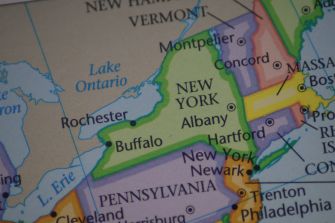
Google Maps is now showing Lake Ontario as “Lake America” to users in the United States after President Donald Trump ordered the federal government to adopt the new name. The change brings the federal designation onto one of the world's most widely used mapping platforms.
Google said U.S. users will see “Lake America,” Canadian users will continue to see “Lake Ontario,” and users elsewhere will see both names. The company updated Maps after the new designation appeared in the federal Geographic Names Information System.
Trump signed an executive order Aug. 27 directing the Interior Department and U.S. Board on Geographic Names to implement the change. Interior Secretary Doug Burgum issued a separate order the same day adopting Lake America for federal use.
Federal agencies now recognize Lake America as the official U.S. name. The change governs federal terminology, maps, and records. The U.S.-Canada border, jurisdiction over the lake, and territorial rights remain unchanged.
Congress gave the Secretary of the Interior and the Board on Geographic Names responsibility for standard geographic names used across the federal government. Under 43 U.S.C. § 364b, the board decides those names subject to the secretary's approval and develops policies intended to serve federal and public interests while accounting for affected federal and state agencies.
Trump's order directs Interior and the board to implement Lake America under that existing legal framework.
The board's own policy gives executive orders significant weight. Its rules state that geographic names established by Congress or presidential order are official and take precedence over the board's ordinary naming procedures.
That interpretation was used after Trump renamed the Gulf of Mexico the Gulf of America in 2025. Board Chairman Michael Tischler said during a meeting in February that presidential directives take precedence over the board's normal policies and procedures. The rapid adoption of Lake America in the federal database indicates the board is taking the same approach.
The process could still face a legal challenge. Any lawsuit under the Administrative Procedure Act would likely focus on Interior or the Board on Geographic Names actions implementing Trump's order, since the Supreme Court has held that the president is not a federal agency subject to APA review. A challenger could argue that the agencies exceeded the authority Congress gave them or failed to follow federal naming law. The government could rely on the board's longstanding policy treating names established by executive order as controlling.
No court has ruled on those questions in connection with Lake America.
The federal change has also produced different responses from private mapping companies. Google adopted Lake America after the Geographic Names Information System changed, while MapQuest has said it will continue using Lake Ontario.
Apple Maps was still displaying Lake Ontario as of Monday. Burgum said Trump had contacted Apple directly about changing the name on its mapping service, though Apple has not announced an update.
New York continues to use Lake Ontario in its own state records and communications. Board on Geographic Names decisions establish terminology for federal agencies, leaving states free to maintain their own naming policies.
The issue is especially relevant in New York because the lake's entire U.S. shoreline borders the state. Gov. Kathy Hochul has rejected the federal designation, and federal naming law requires the board's policies and procedures to account for affected state interests.
The Lake Ontario name is also deeply established across upstate New York, appearing in government programs, tourism organizations, businesses, and communities along the shoreline.
Canada continues to recognize Lake Ontario through its own geographic naming system.
The U.S. Board on Geographic Names maintains procedures for geographic features shared by the United States and Canada. Those rules provide for consultation between the two countries and recognize that each government can use a different official name for the same transboundary feature.
Ontario has its own geographic names board, and Canada's national geographic names database continues to list Lake Ontario as the approved name.
The split has already had practical effects. Some Ontario government websites that rely on Google Maps data briefly displayed Lake America after Google's update, prompting provincial officials to review the affected pages.
Canadian Prime Minister Mark Carney has rejected the U.S. designation. Ontario Premier Doug Ford also pushed back, unveiling a lakeside sign declaring “Lake Ontario: Now and Always.”
Trump issued the renaming order amid continuing trade tensions between the United States and Canada. The administration cited U.S. economic, security and environmental contributions to the Great Lakes and described the lake as an important part of American commerce and history.
Lake Ontario is the smallest of the five Great Lakes by surface area and forms part of the international boundary between the United States and Canada.
The federal designation has now created a split in official and commercial usage. U.S. agencies recognize Lake America; New York and Canada continue to use Lake Ontario, and mapping companies are deciding which name appears to their users.