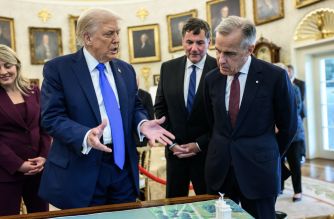
President Donald Trump has escalated the U.S. trade fight with Canada beyond tariffs, ordering outright bans on imports of certain Canadian alcohol, dairy products and motorcycles beginning September 29.
The move raises a legal question that became more important after the Supreme Court curtailed Trump’s tariff authority earlier this year. If Congress holds the constitutional power over tariffs and foreign commerce, what allows a president to prohibit Canadian products from entering the United States altogether?
The White House has identified a specific answer: Section 338 of the Tariff Act of 1930.
The nearly century-old statute allows a president to impose additional duties when another country discriminates against U.S. commerce. If that discrimination continues after an initial presidential proclamation, the law also permits selected products from that country to be excluded from the United States.
Trump invoked that authority Tuesday, September 8, in separate proclamations covering Canadian alcoholic beverages, dairy products and motor vehicles. The exclusions are scheduled to take effect at 12:01 a.m. Eastern time on September 29.
The bans cover most Canadian alcoholic beverages, including various wines, beer and spirits, along with specified dairy-related products and certain motorcycles and mopeds. Other Canadian products remain subject to 50% tariffs rather than outright exclusion.
Trump also directed the General Services Administration to begin removing Canadian-origin products from federal purchasing schedules unless Canada restores what he called “full and fair reciprocity” for U.S. farmers and businesses. That action affects federal procurement rather than imports generally.
The measures came the same day Canadian retaliatory tariffs took effect on approximately $20 billion in U.S. goods. Canada imposed duties ranging from 15% to 50% on products including steel, aluminum, cheese, appliances, clothing, electronics and farm equipment after negotiations between the two countries broke down.
On July 20, Trump issued proclamations finding that Canada was discriminating against U.S. commerce in several areas. The White House cited Canadian restrictions affecting American alcoholic beverages, dairy products, and motor vehicles and imposed additional tariffs of as much as 50% under Section 338.
Section 338 makes the exclusion authority available after the President finds discrimination against U.S. commerce and takes the initial trade action required by the statute. The law creates a two-step process before foreign products can be barred from entering the United States.
First, the President may impose additional duties after finding that a foreign country places unreasonable or unequal restrictions on American products or otherwise discriminates against U.S. commerce. Those duties may reach 50% of the value of the imported goods.
Second, if the foreign country continues or increases the challenged discrimination, the president may issue another proclamation excluding selected products from importation when the president determines that doing so serves U.S. interests.
The September 8 proclamations say Canada maintained the practices identified in July even after the additional tariffs took effect.
The White House says Canada indicated during August negotiations that it would address the disputed measures, prompting Trump to temporarily suspend the new tariffs for three days. The administration says Canada then reversed course on August 21 and failed to remove the practices identified by the United States.
The law also differs sharply from the authority Trump relied on for his earlier global tariffs.
In February, the Supreme Court ruled 6-3 in Learning Resources, Inc. v. Trump that the International Emergency Economic Powers Act, or IEEPA, did not authorize the president to impose tariffs.
The Court emphasized that the Constitution gives Congress the power to impose duties and tariffs and that presidents have no inherent peacetime authority to impose them. Presidential tariff power must therefore come from a congressional delegation.
IEEPA permits presidents responding to declared national emergencies to regulate, block, or prohibit certain economic transactions. The Trump administration argued that its authority to “regulate” imports included the power to tax them through tariffs.
The Supreme Court disagreed.
Section 338 presents a stronger statutory foundation because Congress expressly referred to additional “duties,” set a maximum 50% rate, and separately authorized exclusion of foreign products after specified findings.
The Supreme Court’s February decision emphasized that presidential authority over tariffs and import restrictions must come from powers Congress has delegated by statute.
Section 338 contains such a delegation, but the administration must still comply with the conditions Congress placed in the statute.
A legal challenge could focus on whether the Canadian practices Trump identified qualify as discrimination under Section 338, whether the required sequence of presidential findings and trade measures occurred, and whether the products ultimately excluded are sufficiently connected to the conduct used to justify the restrictions.
The statute’s age and limited modern use could leave judges with relatively little precedent explaining how broadly its provisions should be read.
Congressional Research Service analysis has identified Section 338 as a possible tool for imposing reciprocal trade measures while noting that its use depends on specific statutory findings. The law also allows the president to modify or revoke proclamations when public interests require it and gives the U.S. International Trade Commission a role in monitoring foreign discrimination.
The current dispute could become the first major modern test of how far the law reaches.
Another complication is the U.S.-Mexico-Canada Agreement.
Most Canadian exports to the United States ordinarily receive duty-free treatment under the USMCA when they satisfy the agreement’s requirements. Reuters reports that roughly 80% of Canadian goods shipped to the United States this year entered duty-free under trade-agreement exemptions.
The administration’s Section 338 measures do not recognize those exemptions for affected products.
Canada has argued that the U.S. restrictions violate the trade agreement, raising a separate dispute over obligations between the two countries. A possible violation of an international trade agreement does not automatically answer whether Trump has domestic statutory authority to impose the restrictions. Those issues can proceed through different legal channels, including the USMCA’s dispute-resolution process.
The difference between a tariff and an import ban is substantial.
A 50% tariff makes a Canadian product dramatically more expensive but still allows an importer to bring it into the United States after paying the duty, while an exclusion blocks the affected product from entering the country at all. Goods imported in violation of a Section 338 exclusion may be seized and forfeited under federal customs law.
Trump’s recent threat against Canadian aircraft manufacturer Bombardier remains separate from the bans announced Tuesday.
The president said Monday that Bombardier would no longer be allowed to sell aircraft in the United States unless the company moved manufacturing to the U.S. The administration has not issued a Bombardier-specific Section 338 proclamation or included the company’s business jets in the latest exclusions. Reuters reported Wednesday that Bombardier continues delivering aircraft to U.S. customers.
Trump’s Bombardier statement remains a threat, but the alcohol, dairy and motorcycle restrictions are formal presidential actions with an identified statutory basis and an effective date.
The administration is also continuing to adjust which Canadian products face tariffs rather than bans. A separate September 8 proclamation modified the list of motor-vehicle-related products subject to the 50% Section 338 tariff, with those changes scheduled to begin September 15.
The result is a rapidly changing trade system in which some Canadian goods continue entering duty-free, others face additional tariffs, and another group will be prohibited from entering the United States beginning September 29.
If importers, Canadian companies, or other affected parties challenge the bans, the central legal fight is unlikely to be whether Congress ever gave a president power to exclude foreign goods because Congress did.
The issue instead will be whether the conditions Congress imposed before using that power against these Canadian products exist.