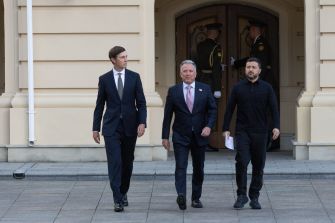
Jared Kushner joined peace talks with Russian President Vladimir Putin on Wednesday, October 21, 2026, a day after participating in negotiations with Ukrainian President Volodymyr Zelensky, as a federal lawsuit seeks to restrict his role as President Donald Trump's diplomatic envoy.
Kushner joined special envoy Steve Witkoff virtually during a meeting with Putin in St. Petersburg, where Russia agreed in principle to resume U.S.-mediated talks with Ukraine, potentially beginning after November 10. The diplomatic developments came one week after a federal watchdog group sued to restrict Kushner's role and compel financial disclosures.
Citizens for Responsibility and Ethics in Washington (CREW) filed the complaint on October 14 in the U.S. District Court for the District of Columbia, alleging that Kushner's diplomatic responsibilities violate constitutional appointment requirements and federal ethics laws.
During Wednesday's three-hour meeting, Witkoff presented Putin with an updated peace proposal developed through discussions with Ukrainian and European officials. The Kremlin's foreign policy adviser, Yuri Ushakov, said Russia was prepared to return to three-way negotiations focused on security arrangements following the war, with Abu Dhabi under consideration as a possible venue.
Russia also released Stephen Hubbard, a 74-year-old American who had spent more than four years in Russian custody after being accused of fighting as a mercenary for Ukraine. Putin announced his release at the beginning of the meeting with Witkoff. Trump said he had personally requested Hubbard's freedom and that the United States made no concessions in exchange.
The previous day's meeting in Oslo brought together Zelensky, Norwegian Prime Minister Jonas Gahr Støre, Finnish President Alexander Stubb and European representatives. Norway's government confirmed that Ukraine requested the participation of both American envoys, with Kushner joining remotely.
Discussions focused on a framework for ending Russia's war in Ukraine, including security guarantees and potential limits on attacks against energy infrastructure. According to Axios, Kushner pressed Trump's demand that Ukraine halt strikes on Russian oil refineries. Zelensky indicated that Kyiv would consider reciprocal restrictions if Moscow agreed to similar measures.
CREW's lawsuit contends that Kushner's continuing involvement in major foreign policy decisions makes him a federal officer under the Constitution's Appointments Clause, which generally requires presidential nomination and Senate confirmation for principal officers. Certain lower-ranking officials may be appointed through other procedures authorized by Congress.
The organization also seeks financial disclosures related to Kushner's investment firm, Affinity Partners, which manages more than $6 billion in assets. The firm has substantial backing from sovereign wealth funds in Saudi Arabia, Qatar, and the United Arab Emirates. CREW argues that those investments create potential conflicts involving countries connected to his diplomatic assignments.
Kushner's attorney, Chad Mizelle, has rejected the allegations, saying government and outside ethics attorneys reviewed the volunteer arrangement and determined that it complies with applicable requirements. The White House maintains that Kushner receives no government compensation, covers his expenses, and keeps his business interests separate from his diplomatic work.
CREW has publicly objected to Kushner's continued participation in negotiations with Zelensky, arguing that his responsibilities require formal appointment and financial disclosures. The lawsuit remains pending, and no court order has been issued barring his diplomatic activities.
The case remains before the U.S. District Court for the District of Columbia, where the court has yet to rule on CREW's challenge to Kushner's appointment and financial disclosure obligations.