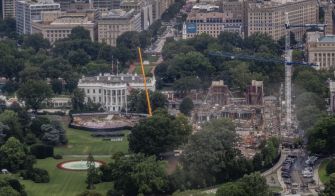
Photo Source: AP Photo/Tierney L. Cross via apnews.com
The Supreme Court on Monday allowed President Donald Trump to keep building his $400 million White House ballroom, ruling 5-4 that the historic preservation group challenging the project is unlikely to have the legal standing needed to stop construction.
The decision keeps a lower court injunction on hold, allowing above-ground work to continue while the case proceeds. The justices did not decide whether Trump has legal authority to build the ballroom without specific approval from Congress, leaving the central dispute over the project's legality unresolved.
Chief Justice John Roberts joined Justices Sonia Sotomayor, Elena Kagan and Ketanji Brown Jackson in dissent. Roberts called the construction “likely unlawful” and argued that the case raises serious questions about the constitutional separation of powers and Congress' control over federal property and spending. He wrote that “The White House is not just any building.”
Instead of resolving those questions, the majority focused on whether the National Trust for Historic Preservation can bring the lawsuit at all. That requirement, known as standing, generally requires a plaintiff to show a concrete and personal injury caused by the action being challenged.
The Trust argued that the ballroom would harm the historic and aesthetic interests of its members, including architectural historian Alison Hoagland, who lives in Washington and regularly visits the area around the White House. The majority found the administration was likely to succeed in arguing that those interests were not enough to establish standing.
That finding could shape the entire case. If the Trust cannot show that one of its members suffered the type of injury required to sue, a federal court cannot decide its broader claims over Trump's authority to build the ballroom, regardless of how those claims might otherwise be resolved.
The dispute began after Trump moved forward with plans to replace the demolished White House East Wing with a roughly 90,000-square-foot ballroom. The president has estimated the project will cost about $400 million and has said the ballroom itself will be financed through private donations.
Plans for the site also include underground military, medical and security facilities. The administration says those facilities and the ballroom form an integrated complex designed in part to protect the president, senior officials and visiting dignitaries.
After construction began without specific congressional approval, the National Trust sued. The group argues that federal law does not give the president or the National Park Service authority to undertake the above-ground project on their own.
One law at the center of the dispute generally bars the construction of a building or structure in federal parkland in Washington without express authority from Congress. The administration has argued that other federal laws give the National Park Service sufficient authority to carry out improvements on the White House grounds.
U.S. District Judge Richard Leon sided with the Trust on March 31 and issued a preliminary injunctionA preliminary injunction is a temporary court order issued before a case is finally decided that requires a party to take or stop an action while the litigation continues. Federal courts generally consider the likelihood of success, irreparable harm, the balance of equities, and the public interest before granting one.Read more → against above-ground construction. Leon found the group was likely to succeed on its claim that the administration had not identified sufficient legal authority to build the ballroom as planned.
A divided U.S. Court of Appeals for the D.C. Circuit upheld that injunction on August 7. In its 2-1 ruling, the appeals court concluded that Congress holds constitutional authority over federal property and that the administration had not shown lawmakers transferred enough of that power to the president or the National Park Service for the ballroom project.
The injunction would have stopped most above-ground work while allowing construction of underground security facilities and other activity needed to protect the White House and the site.
Seeking to avoid that halt, the administration asked the Supreme Court to intervene. Government lawyers argued that separating the ballroom from the underground complex would create national security, engineering and financial problems because the facilities are being built as parts of the same project.
Officials also told the justices that the overall project was already about 65% complete when the government sought emergency relief in August.
Roberts temporarily allowed construction to continue on August 21 while the full Court considered the administration's request. Monday's 5-4 decision now keeps the lower court injunction on hold as the government prepares to ask the Supreme Court to take up the case.
The ruling gives Trump an immediate victory over the effort to stop construction, but the broader legal question remains unsettled. Whether a court ultimately decides if the president had authority to undertake the White House ballroom project without further action by Congress may first depend on whether the National Trust can establish its right to sue.
Share This Article
If you found this article insightful, consider sharing it with your network.
Bridget studied Communications and Marketing at California State University, Long Beach. She also has experience in the live music events industry, which has allowed her to travel to festivals around the world. During this period, she acquired valuable expertise in branding, marketing, event planning, and public relations.
A federal judge has found that the Trump administration likely exceeded its authority when it waived dozens of federal laws to build border barriers in Texas's Big Bend region, citing evidence that the sprawling sector has the lowest migrant apprehension rates along the U.S.-Mexico border.In a 14-page opinion issued October...
Read
More »
Arlington County, Virginia, sued the Trump administration Thursday to stop construction of President Donald Trump's planned 250-foot triumphal arch near Arlington National Cemetery, alleging federal officials are moving toward building the monument without adequately examining its effects on public safety, traffic and historic landmarks.The October 8, 2026, complaint, filed in...
Read
More »
A federal judge has again blocked efforts to place President Donald Trump’s name on the Kennedy Center, ruling that the board overseeing the performing arts institution cannot rename the building, its grounds or its public spaces without approval from Congress.U.S. District Judge Christopher Cooper issued the ruling Tuesday, September 15,...
Read
More »
The Supreme Court has temporarily cleared the way for President Donald Trump’s administration to continue construction of the White House ballroom, stopping a lower court injunction from taking effect while the justices consider the administration’s emergency request.Chief Justice John Roberts issued the order Friday, hours before restrictions on much of...
Read
More »
A federal judge has ordered President Donald Trump’s administration to give more than 30 days’ written notice before demolishing the Kennedy Center’s main building or making major changes to its renovation plans, one day after Trump said the Washington performing arts venue could be “ripped down.”U.S. District Judge Christopher Cooper...
Read
More »
We use cookies and similar technologies to help our website function, understand how visitors use our site, and improve your experience. Some cookies are necessary for the website to operate, while others may be used for analytics or advertising.