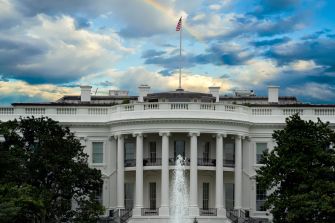
The Supreme Court has temporarily cleared the way for President Donald Trump’s administration to continue construction of the White House ballroom, stopping a lower court injunction from taking effect while the justices consider the administration’s emergency request.
Chief Justice John Roberts issued the order Friday, hours before restrictions on much of the construction were set to begin. His brief order stays an April injunction from a federal judge in Washington, D.C., “pending further order” from Roberts or the Supreme Court.
Construction can continue while the Court considers the administration’s request, but the order does not decide whether the White House has legal authority to build the ballroom without additional approval from Congress. The Supreme Court gave no reasoning for the temporary stay.
The administration sought emergency relief on August 13, arguing that stopping construction would interfere with national security and presidential protection. Its filing describes the ballroom as part of a larger complex that includes underground security facilities and says the above-ground and below-ground portions share an integrated structural design.
Government lawyers told the Court that the overall project is about 65 percent complete and that approximately 250 workers have been operating as much as 20 hours a day, seven days a week. The administration argues that halting the work at this stage would create significant construction problems and that major changes to the structure are no longer practical.
Friday’s intervention follows an August 7 ruling from a divided panel of the U.S. Court of Appeals for the District of Columbia Circuit. The appeals court upheld the injunction after concluding that the administration had not shown it could undertake construction of that scale without congressional authorization. Enforcement was delayed for two weeks to give the government time to seek relief from the Supreme Court.
At the center of the dispute is 40 U.S.C. Section 8106, a federal law restricting construction on public grounds in Washington without express authority from Congress. Solicitor General D. John Sauer argues that other federal laws already give the president authority to make alterations and improvements to the White House and allow federal agencies to construct buildings on national park property.
The National Trust for Historic Preservation, which brought the lawsuit, disputes that interpretation. It argues that the Constitution gives Congress authority over federal property and that the laws cited by the administration do not provide the express congressional approval required under Section 8106 for a project of this size.
For readers, the distinction now before the courts is whether existing federal authority covering White House improvements is broad enough to permit the ballroom or whether Congress must specifically authorize the project. Roberts’ stay does not answer that question. It only determines what happens to construction while the Supreme Court considers the government’s request.
In opposing the stay, the National Trust also challenged the administration’s national security argument. The organization told the Court that the lower court injunction already permitted underground construction and other work necessary to protect the president, White House personnel and the property.
Continued above-ground construction, the group argued, could make judicial review less effective if the ballroom becomes too advanced to modify or remove before the courts determine whether the project was properly authorized.
Government lawyers responded that the security facilities and ballroom cannot realistically be treated as separate projects because they share structural and engineering systems. Stopping the above-ground work, the administration argues, could therefore affect construction throughout the complex.
The dispute began after the administration moved forward with demolition of the former East Wing and construction of the new facility. Plans call for a roughly 90,000-square-foot ballroom, with the administration estimating that about $400 million in private donations will fund the project.
The administration’s emergency application remains before the Supreme Court. The Court has not announced when it will take further action in the case.