
Trump Eases Independent Contractor Rules, Reversing Biden Policy

by Lawrence J. Tjan | Nov 19, 2026
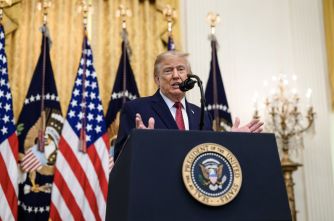
Donald Trump speaks at a podium bearing the presidential seal with American flags behind him.
Photo Source: Official White House Photo

The Trump administration on Thursday finalized a rule making it easier for businesses to classify workers as independent contractors rather than employees, reversing a Biden-era standard for determining eligibility for federal workplace protections.

The U.S. Department of Labor announced the change on November 19, 2026, revising how federal officials determine which workers qualify for minimum wage and overtime protections. The regulation could affect businesses that rely on contract labor in construction, transportation, delivery services, and other industries.

Under the new standard, federal investigators will give the greatest weight to how much control workers have over their jobs and whether they can increase profits or incur losses through their own business decisions. Workers who control their schedules, choose assignments, and manage their investments may be more likely to qualify as independent contractors.

The revised test also considers workers' skills, the duration of their relationship with a company, and whether their services are integrated into its production process. These factors help determine whether workers depend on an employer for work or operate businesses of their own.

The Biden administration's 2024 regulation required officials to consider six factors without assigning greater importance to any one of them. The new approach largely restores a framework adopted during Trump's first term in 2021, placing greater emphasis on control and opportunities for independent earnings.

The Biden-era regulation had faced legal challenges from business groups, including the National Federation of Independent Business, which argued that the classification standard increased compliance costs and created uncertainty for smaller employers. The organization joined litigation seeking to overturn the 2024 rule.

The Labor Department had already directed investigators in May 2025 to stop applying the Biden-era standard in federal wage investigations while the agency reconsidered the policy. Thursday's final rule formally replaces the 2024 regulation.

Worker advocates have warned that broader independent contractor classification could leave more workers outside federal wage protections. Employees covered by the Fair Labor Standards Act generally qualify for minimum wage and overtime pay, while independent contractors are responsible for managing their own business expenses and earnings.

The regulation also applies the revised classification standard under the Family and Medical Leave Act and the Migrant and Seasonal Agricultural Worker Protection Act, extending its reach to federal laws governing family leave and certain agricultural employment protections.

State employment laws will continue to apply independently. California, for example, generally requires businesses to satisfy a stricter three-part test for many contractor arrangements, although exceptions apply to certain occupations. Federal tax rules also follow separate classification requirements.

The Labor Department developed the rule following a February proposal and public comment period. The final regulation includes examples involving digital platform workers, truck drivers, and agricultural labor contractors to clarify how the standard applies to different working relationships.

The rule will take effect 60 days after publication in the Federal Register, giving businesses time to review their worker classification practices under the revised federal standard.

Share This Article

If you found this article insightful, consider sharing it with your network.

Get more Law Commentary in Google's Top Stories.

Lawrence J. Tjan
Lawrence is an attorney and CEO of Law Commentary. Lawrence draws on his legal and business experience to help make court decisions, litigation, legislation, public policy, and other legal developments more accessible to the general public and to give readers clear context for understanding the law and how it affects businesses, consumers, and communities.

Related Articles

U.S. Department of Labor building facade with the agency’s name displayed above the entrance.

Labor Department Seeks to Ease Rules for Disqualified Fund Managers

The Trump administration is proposing to make it easier for investment firms disqualified over criminal convictions or other misconduct to continue managing retirement funds under a federal exemption that allows certain transactions otherwise barred by law.The U.S. Department of Labor announced the proposal Tuesday, November 17, 2026, offering eligible investment... Read More about Labor Department Seeks to Ease Rules for Disqualified Fund Managers

Close-up of U.S. Permanent Resident Cards, commonly known as green cards, overlapping on a surface.

Labor Department Proposes Stricter Green Card Rules for U.S. Employers

The U.S. Department of Labor proposed new restrictions on employment-based green cards on November 16, 2026, requiring companies to expand recruitment of American workers, limiting sponsorship following layoffs and eliminating exemptions for certain healthcare professionals.The proposed overhaul of the Permanent Labor Certification (PERM) program would affect employers seeking to sponsor... Read More about Labor Department Proposes Stricter Green Card Rules for U.S. Employers

Criminal background check form labeled “Criminal Background Check” with eyeglasses and an orange pencil.

EEOC Scraps Obama-Era Guidance on Criminal Background Checks

The U.S. Equal Employment Opportunity Commission has withdrawn Obama-era guidance advising employers against using arrest and conviction records in ways that discriminate against job applicants, ending a 14-year-old federal policy governing criminal background checks in employment decisions.The agency announced Thursday, October 29, 2026, that commissioners voted Wednesday to rescind the... Read More about EEOC Scraps Obama-Era Guidance on Criminal Background Checks

U.S. Department of Homeland Security building with an American flag and agency sign.

DHS Finalizes Rule Ending Automatic Work Permit Extensions for Immigrants

The Department of Homeland Security finalized a rule Wednesday ending automatic work permit extensions for certain immigrants awaiting renewal approval, leaving affected workers at risk of losing their authorization to work while federal officials process their applications.Published October 14, 2026, the final regulation permanently adopts restrictions that took effect under... Read More about DHS Finalizes Rule Ending Automatic Work Permit Extensions for Immigrants

Close-up of a smartphone screen displaying a government web page titled H-1B Program.

Trump Administration Moves to End 60-Day Grace Period for Laid-Off H-1B Workers

The Trump administration is proposing to eliminate a rule that gives many H-1B visa holders up to 60 days to remain in the United States after losing their jobs, potentially forcing thousands of foreign workers and their families to make immigration decisions almost immediately after employment ends.The Department of Homeland... Read More about Trump Administration Moves to End 60-Day Grace Period for Laid-Off H-1B Workers

Legal term

Search articles and Legalpedia

Subscribe to Newsletter