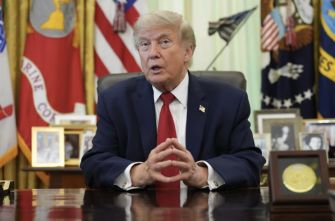
President Donald Trump signed two executive orders Thursday seeking to deny birthright citizenship to children in several defined groups and increase enforcement against foreign visitors who travel to the United States to give birth.
The action marks a narrower attempt to limit citizenship at birth after the Supreme Court rejected Trump’s earlier policy on June 30. That order would have affected children born to undocumented immigrants and people temporarily in the country when neither parent was a U.S. citizen or permanent resident.
One of the new directives tells federal agencies not to recognize citizenship for children whose parents fall into categories that the administration says are outside the protection of the Fourteenth Amendment. Those groups include some foreign government employees, people classified as alien enemies, and parents accused of using fraud or commercial arrangements to secure U.S. citizenship for a child.
A second order directs the State and Homeland Security departments to strengthen enforcement against birth tourism, a term used for travel to the United States for the purpose of giving birth. The agencies may revise visa rules, deny or revoke visas, and take action against people or businesses that arrange the travel.
Federal policy already restricts the use of tourist visas for that purpose. A rule adopted in 2020 allows consular officers to deny a visitor visa when they determine that an applicant’s primary reason for traveling is to give birth so the child will become a U.S. citizen.
The existing rule governs whether a foreign national may enter the country. It does not change the citizenship status of a child born in the United States, a distinction the new orders place at the center of the administration’s renewed effort.
Trump first sought to limit birthright citizenship through an executive order signed on his first day back in office in January 2025. The policy directed federal agencies not to recognize the citizenship of children born to parents who were unlawfully or temporarily present unless the other parent was a citizen or permanent resident.
Several federal courts blocked that order before it took effect. The Supreme Court later rejected the administration’s position in a 6-to-3 decision, holding that children born in the country to undocumented immigrants and temporary visitors are subject to U.S. jurisdiction and receive citizenship at birth.
The Citizenship Clause of the Fourteenth Amendment states that people born or naturalized in the United States and subject to its jurisdiction are citizens. Courts have long read the clause to cover nearly everyone born on U.S. soil, regardless of a parent’s immigration status.
Recognized exceptions are limited. Children born to accredited foreign diplomats generally do not receive citizenship because diplomatic immunity places their parents outside ordinary U.S. legal authority. Courts have also described an exception for children born to members of a foreign enemy force occupying American territory.
The Trump administration argues that the new order remains within those established limits rather than reviving the broader policy rejected by the Supreme Court. The directive extends the foreign government category beyond ambassadors to include some embassy, consular and other government employees.
Diplomatic immunity depends on a person’s official position and status. Employment by a foreign government alone does not give every worker the same immunity held by an accredited diplomat, leaving the new category broader than the traditional diplomatic exception.
The order also covers children of some people classified as alien enemies, including individuals tied to designated terrorist organizations. Courts have historically discussed the exception in connection with an occupying military force. The new directive relies on federal terrorism and alien enemy classifications as additional grounds for withholding citizenship.
Birth tourism presents a different issue because the administration’s theory rests on alleged deception by a parent. Immigration authorities may deny a visa, revoke permission to enter, or pursue removal when a foreign national lies about the purpose of a trip.
Citizenship at birth is not obtained through an application submitted by the child. It arises automatically when the requirements of the Fourteenth Amendment are met. The new order directs agencies to treat some parental fraud and commercial childbirth arrangements as grounds for finding that the child never qualified for citizenship.
Administration officials argue that people who deceptively enter the country to obtain citizenship for a newborn do not fall within the rule recognized by the Supreme Court. The order does not rely solely on whether the parent violated immigration law. It claims that the circumstances of the entry place the resulting birth outside the constitutional guarantee.
An executive order may direct the work of federal agencies when the president acts under constitutional authority or power granted by Congress. It cannot amend the Constitution or displace a Supreme Court ruling, and its implementation remains subject to review in federal court.
The citizenship directive requires federal agencies to publish implementation guidance within 30 days. The State and Homeland Security departments must also revise rules, policies, and enforcement guidance to carry out the separate birth tourism order.