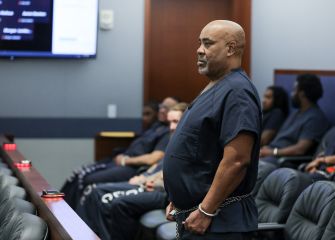
The murder trial of Duane “Keffe D” Davis began Monday in Las Vegas, nearly 30 years after Tupac Shakur was killed in a drive-by shooting that became one of the most notorious unsolved cases in music history.
In opening statements, prosecutors told jurors that Davis helped orchestrate the September 1996 attack as retaliation for a fight earlier that night involving Shakur and Davis’ nephew, Orlando Anderson. Davis, 63, is not accused of being the gunman. Instead, prosecutors allege that he organized the retaliation, obtained the weapon and helped put the shooters in position to carry out the attack.
Prosecutor Binu Palal told jurors that the case would rely heavily on Davis’ own accounts of the shooting. Over the years, Davis has spoken publicly about the night Shakur was killed, including in interviews and his 2019 memoir, Compton Street Legend.
Prosecutors played excerpts of those statements in court Monday, arguing that they provide a detailed account of Davis’ involvement. In one version of events described by Davis, he was sitting in the front of the vehicle when the shots were fired and had provided the gun to a passenger in the backseat. Palal argued that Davis’ repeated descriptions of the shooting were consistent with the prosecution's theory that he helped arrange the attack.
The alleged motive dates to an altercation at the MGM Grand earlier on Sept. 7, 1996. Shakur and members of his entourage confronted Anderson inside the casino after an earlier dispute between the two groups. Prosecutors say the confrontation became the catalyst for what happened later that night. Shakur, who was in Las Vegas with Death Row Records co-founder Marion “Suge” Knight, was traveling in a BMW when a Cadillac pulled alongside the vehicle near the Las Vegas Strip. Gunfire erupted, striking Shakur four times. Knight was also wounded, while the attackers escaped.
Shakur was taken to University Medical Center, where he died six days later at 25. At the time, the killing unfolded against the backdrop of the highly publicized rivalry between the East Coast and West Coast hip-hop scenes. The death of The Notorious B.I.G. in Los Angeles the following year further fueled speculation that the two killings were connected to the escalating feud. Despite years of investigation and widespread public interest, neither murder resulted in an immediate prosecution.
Davis became the first person to face a criminal charge in Shakur’s killing when a Nevada grand jury indicted him in September 2023. Investigators had spent years examining his statements and his alleged connections to people involved in the shooting. His public comments eventually became a major part of the case, particularly because he had discussed the shooting in detail rather than simply being identified by witnesses as someone connected to the events.
The defense, however, disputes the prosecution's interpretation of those statements. Davis has pleaded not guilty and has maintained that he did not orchestrate Shakur’s murder. His attorneys have also argued that portions of his memoir were fictionalized or exaggerated for entertainment purposes, raising questions about how much weight jurors should give his descriptions of the shooting. The judge has allowed prosecutors to introduce the book and other statements as evidence, meaning jurors will ultimately have to decide whether Davis was accurately describing his role or telling stories that should not be treated as admissions of guilt.
Prosecutors do not have to prove that Davis personally fired the fatal shots. Their case instead depends on establishing that he knowingly participated in a plan that resulted in Shakur’s death. The state will therefore seek to connect Davis’ alleged actions before and during the shooting with the legal requirements for a murder conviction, while the defense is expected to challenge both the reliability of his past statements and the evidence linking him to the attack.
The trial is expected to last several weeks and could feature testimony from a number of witnesses connected to the investigation and the events surrounding Shakur’s final hours. Knight, who is serving a prison sentence on an unrelated case, could also testify. Prosecutors are expected to present evidence about the MGM Grand confrontation, Davis’ alleged role in the shooting and his statements over the years. The defense will then have an opportunity to challenge that evidence and present its own account of what happened.
Shakur’s murder has remained a defining mystery in hip-hop for nearly three decades, spawning countless theories about who ordered the attack and why. The case finally reached a courtroom after investigators renewed their efforts and prosecutors obtained an indictment against Davis in 2023. Now, for the first time, a jury will hear the state's complete case against a defendant accused of helping arrange the killing.
If convicted, Davis could receive life in prison without the possibility of parole.