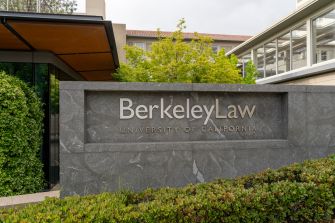
The Justice Department accused UC Berkeley School of Law on Wednesday of illegally favoring Black applicants over white and Asian candidates, alleging the school continued to weigh race in admissions after the Supreme Court struck down race-conscious college admissions in 2023.
A joint investigation by the Justice and Education departments found Berkeley Law violated Title VI of the Civil Rights Act when selecting its incoming classes of 2024 and 2025. Federal officials said the discrimination is ongoing and are seeking an agreement requiring changes to the school’s admissions practices.
Berkeley rejected the findings. Law school Dean Erwin Chemerinsky said the school “scrupulously complies” with federal law, the Constitution and California law and maintains a policy that race is not considered in admissions decisions.
UC Berkeley said it would provide evidence showing its admissions process complies with applicable laws and policies.
The federal investigation began in March 2025 as a review of UC Berkeley admissions and expanded to the law school the following month. Investigators examined applicant data, application materials and public statements by Berkeley officials before concluding that the school deliberately discriminated against white and Asian applicants.
The Justice Department pointed to admissions data showing Black applicants in 2025 had 5.8 times the odds of admission as comparable white applicants. DOJ said the disparity was 6.5 times in 2024 and found a similar pattern involving Asian candidates.
The findings letter does not detail the statistical model the department used to calculate those differences.
DOJ also cited LSAT differences among admitted students. The median score for admitted Black applicants in 2025 was 167, compared with 172 for both white and Asian applicants, with similar gaps appearing in previous years. Berkeley Law evaluates applicants using additional factors, including academic achievement, recommendations, work experience and public service.
Application questions also drew scrutiny from federal investigators.
One prompt invited candidates to discuss how their perspective, experiences or voice would contribute to diversity at the law school and identified race and ethnicity among subjects applicants could address. Another asked applicants who felt supported by sharing a “primary identity” with other students to choose from a list that included racial and ethnic groups.
DOJ contends the questions allowed Berkeley to continue considering race indirectly after the Supreme Court’s 2023 decision in Students for Fair Admissions v. Harvard.
The ruling struck down the admissions programs used by Harvard University and the University of North Carolina and sharply restricted the use of race in college admissions. The Supreme Court left schools room to consider how an applicant’s experiences shaped qualities or accomplishments relevant to admission, including experiences involving race.
Universities cannot use essays or other criteria to recreate an admissions preference based on racial identity. DOJ alleges Berkeley crossed that line by using application questions and other measures to pursue its diversity goals. Berkeley maintains that applicants receive no preference based on race.
The Justice Department also cited comments Chemerinsky made before and after the Supreme Court ruling about ways universities could maintain diversity without explicitly granting racial preferences.
Its findings letter referenced a 2022 interview in which Chemerinsky discussed the use of “proxies for race” if affirmative action were eliminated. Investigators relied on those remarks, along with admissions data and application materials, in finding that Berkeley deliberately continued race-conscious admissions.
Chemerinsky disputes the department’s interpretation. He has maintained that universities may pursue a diverse student body while evaluating applicants individually and complying with the Supreme Court ruling.
California has imposed its own restrictions on race-conscious admissions for three decades. Proposition 209, approved by voters in 1996, bars the state’s public institutions from granting preferential treatment based on race, sex, color, ethnicity or national origin in public education and other areas.
The Justice Department’s findings are an administrative determination, rather than a court ruling that Berkeley violated federal law. Title VI prohibits racial discrimination by institutions that receive federal financial assistance and allows the government to seek compliance after finding a violation.
DOJ is seeking a voluntary resolution agreement requiring changes to Berkeley Law’s admissions and oversight practices. If the university and federal government fail to reach an agreement, the department said it can file a lawsuit.