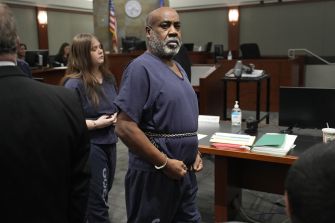
A Las Vegas jury found Duane “Keffe D” Davis guilty of first-degree murder Monday in the 1996 killing of Tupac Shakur, making the former gang leader the first person convicted in the rapper’s death nearly 30 years after the fatal drive-by shooting.
Jurors deliberated for less than three hours on Aug. 31 before convicting Davis, 63, of murder with the use of a deadly weapon. He is scheduled to be sentenced Oct. 13 and faces as much as life in prison without the possibility of parole. Davis told the court after the verdict that he plans to appeal.
Davis was not accused of firing the shots that killed Shakur. Prosecutors instead argued that he organized the retaliatory attack, obtained the gun, and passed it to the back seat of the white Cadillac from which Shakur was shot.
Under Nevada law, a person can be convicted as a principal to a crime even without personally carrying out the act. Someone who aids or abets an offense, or who commands, encourages, or helps another person commit it, can be prosecuted and punished as though that person committed the crime directly. That allowed prosecutors to seek a murder conviction without proving Davis pulled the trigger.
The state's case relied heavily on Davis' own accounts of the shooting, including a recorded 2008 police interview, later media appearances, and his 2019 memoir, “Compton Street Legend.” Prosecutors argued that while details changed across his retellings, Davis repeatedly placed himself inside the Cadillac and described helping provide the weapon used in the attack.
In the 2008 interview, Davis told investigators he was riding in the front passenger seat with his nephew Orlando “Baby Lane” Anderson, DeAndre “Dre” Smith and driver Terrence “Bubble Up” Brown. Davis said he passed a loaded .40-caliber Glock to the back seat and identified Anderson as the gunman. The other three men prosecutors said were inside the Cadillac have since died.
Former Los Angeles police detective Daryn Dupree testified that Davis first raised the Shakur shooting while detectives were questioning him about the unrelated 1997 killing of Christopher Wallace, the rapper known as the Notorious B.I.G. Dupree said Davis denied involvement in Wallace's death but volunteered, “We did the other one.”
The investigation also extended to Sean “Diddy” Combs. Dupree testified that Davis later worked as a confidential informant and tried to corroborate his claim that Combs had offered money for Shakur's killing through an intermediary, but investigators were unable to substantiate the allegation. Prosecutors did not accuse Combs of involvement in Shakur's murder, and Combs has long denied any connection to the killing.
The 2008 interview became a major issue before trial. Davis' attorneys argued that statements he made to investigators were protected and should not be used against him. Clark County District Judge Carli Kierny ruled before trial that the recording could be admitted. Prosecutors had argued that Davis could not keep the interview out after later discussing the killing publicly and publishing an account in his memoir.
The shooting followed a confrontation at the MGM Grand casino on Sept. 7, 1996. Surveillance footage showed Shakur, Death Row Records co-founder Marion “Suge” Knight and others attacking Anderson after a Mike Tyson boxing match. Prosecutors said Davis, a leader of the South Side Compton Crips, then organized an armed retaliation against Shakur and Knight.
Hours later, Shakur was riding with Knight in a BMW near Flamingo Road and Koval Lane when the white Cadillac pulled alongside them, and gunfire erupted. Shakur was struck multiple times and died six days later at age 25. Knight was wounded but survived.
Prosecutors told jurors that the attack was the result of a plan rather than an impulsive confrontation. They argued Davis and the other men searched for Shakur after the casino fight before eventually spotting the BMW on the road.
Defense attorney Michael Sanft argued that Davis' statements were unreliable stories that grew through repeated interviews, media appearances, and his memoir. He emphasized inconsistencies among the accounts and argued prosecutors lacked physical evidence establishing that Davis was in Las Vegas or inside the Cadillac when Shakur was shot.
Sanft also pointed to specific details that witnesses disputed. Davis wrote that a nearby Chrysler Sebring carrying several women was struck by gunfire during the shooting, but a woman who was inside that vehicle testified that the car was not hit.
Prosecutors countered that inconsistencies in Davis' accounts did not erase the central details he repeated over the years, including that he was in the Cadillac, that his group was seeking retaliation after Anderson was beaten, and that he supplied the gun that was passed into the back seat.
Davis did not testify in his own defense.
Shakur's sister, Sekyiwa Shakur, cried and embraced people in the courtroom after the verdict was announced. Davis remained held without bail following the conviction and is scheduled to return to court for sentencing on Oct. 13.