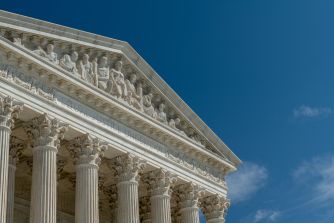
The U.S. Supreme Court has rejected a former Pennsylvania judge’s First Amendment challenge to his suspension over pro-Democrat Facebook posts, leaving in place a ruling that gives the state broad authority to restrict partisan political speech by judges serving on the bench.
The justices denied Mark B. Cohen’s petition on October 5, 2026, without explanation. Cohen, a former Philadelphia Court of Common Pleas judge and longtime Democratic state legislator, had asked the court to review whether Pennsylvania used the wrong constitutional standard when it punished him for political posts on Facebook.
The Supreme Court’s refusal to hear the case does not endorse Pennsylvania’s reasoning or create a nationwide rule. It leaves unresolved a broader First Amendment question over how far states may go in restricting the political speech of sitting judges.
Cohen was suspended without pay in October 2024 for the remainder of his judicial term, which expired December 31, 2024. His challenge continued because the discipline carried additional consequences, including the loss of his judicial pension, according to his Supreme Court petition.
At the center of the case was a constitutional test.
Cohen argued that Pennsylvania should have applied strict scrutiny, one of the most demanding standards courts use when reviewing government restrictions on speech. The U.S. Supreme Court has applied that standard in some cases involving restrictions on judicial candidates.
The Pennsylvania Supreme Court took a different approach for judges already serving on the bench.
In its January 21, 2026, ruling, the court held that judges speaking outside their official duties on matters of public concern are subject to a balancing test. That test weighs the judge’s free speech interests against Pennsylvania’s interest in protecting judicial independence, integrity, impartiality, and public confidence in the courts.
The court concluded that Pennsylvania’s interests outweighed Cohen’s right to engage in the partisan political activity at issue.
Before becoming a judge, Cohen spent 42 years as a Democratic member of the Pennsylvania House of Representatives. He was elected to the Philadelphia Court of Common Pleas in 2017 and joined the bench the following year.
Cohen continued using a public Facebook account that identified him as a judge and detailed his previous political career. The page had approximately 5,000 friends and 1,000 followers.
The Judicial Conduct Board focused on 66 posts it considered partisan. They included messages praising President Joe Biden, supporting Democratic-backed policies and criticizing conservative positions and Republican political figures.
In one November 2022 post, Cohen called Biden an “excellent President.” Other posts supported student loan forgiveness, promoted Build Back Better legislation and criticized then-House Republican leader Kevin McCarthy.
Cohen maintained that he was commenting on matters of public concern rather than improperly using his judicial office for partisan political activity.
Pennsylvania’s courts found that the overall volume and tone of the posts crossed that line. The state Supreme Court concluded that Cohen had publicly advocated for Democratic political interests while serving as a judge and that Pennsylvania’s interest in preserving the judiciary’s reputation for impartiality outweighed his speech interests.
The distinction between judicial candidates and sitting judges became critical to the case.
Candidates seeking judicial office retain substantial First Amendment protections when discussing political and legal issues. Pennsylvania concluded that judges already on the bench can face tighter restrictions because their public conduct may affect confidence that cases will be decided impartially.
Justice David Wecht, writing separately, warned that judges must exercise particular care in an era of widespread social media and intense partisan debate.
Cohen took the dispute to the U.S. Supreme Court on April 21, 2026, asking the justices to decide whether Pennsylvania should have applied strict scrutiny to the restrictions on his speech. The Judicial Conduct Board opposed review. The case was distributed for the court’s September 28 conference before the petition was denied on October 5.
The denial leaves Pennsylvania’s balancing test in place within the state while allowing courts elsewhere to confront the same First Amendment issue under different approaches.
Until the Supreme Court takes up the question, the constitutional boundary between a judge’s right to speak about politics and a state’s power to protect the appearance of judicial impartiality remains unsettled nationwide.