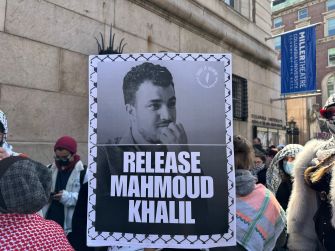
Mahmoud Khalil, the former Columbia University graduate student who spent 104 days in immigration detention over his pro-Palestinian activism, asked the U.S. Supreme Court on October 19, 2026, to overturn a ruling that could send him back into ICE custody as the Trump administration pursues his deportation.
Khalil, a lawful permanent resident, is challenging a federal appeals court decision that overturned a judge's order releasing him from detention. His attorneys argue that the ruling could force immigrants to remain imprisoned for months or years before federal judges can review claims that their confinement violates the Constitution.
The petition asks the justices to decide whether federal district courts can hear constitutional challenges to immigration detention through habeas corpus, a legal procedure allowing people to contest unlawful confinement.
Immigration agents arrested Khalil on March 8, 2025, at his Columbia University residence in New York. Authorities transferred him to Louisiana, where he remained detained until U.S. District Judge Michael Farbiarz ordered his release on June 20, 2025, after finding that his continued confinement was likely unconstitutional.
Farbiarz had previously ruled that Khalil was likely to succeed in challenging the administration's use of a foreign policy provision to justify his detention. The government appealed, arguing that federal immigration law required Khalil to pursue his claims through the deportation process.
On January 15, 2026, a three-judge panel of the U.S. Court of Appeals for the Third Circuit sided with the administration and overturned the district court's orders. The panel found that the Immigration and Nationality Act required Khalil to pursue judicial review through the immigration system, with federal appellate review available after a final removal order. The decision effectively barred his constitutional detention claims from proceeding before the district judge.
Khalil's attorneys say the ruling could allow immigration authorities to keep people in custody while constitutional challenges move through lengthy deportation proceedings. They argue that federal judges must retain the authority to promptly review claims of detention imposed in retaliation for protected political speech.
Secretary of State Marco Rubio invoked a rarely used immigration provision to seek Khalil's removal, determining that his activities threatened U.S. foreign policy interests. Federal officials accused him of contributing to an antisemitic environment at Columbia during demonstrations against Israel's military campaign in Gaza.
Khalil denies the allegations and maintains that the administration targeted him for political advocacy protected by the First Amendment. His case has become a prominent legal challenge to the administration's use of immigration enforcement against foreign students and activists involved in pro-Palestinian demonstrations.
Khalil suffered another setback on May 22, 2026, when the Third Circuit rejected his request for a full-court rehearing in a 6-5 vote. Five judges supported reconsidering the decision, with Judge Cheryl Ann Krause warning in a dissent joined by Judges Luis Felipe Restrepo and Arianna Freeman that the ruling improperly restricted federal courts' authority to protect constitutional rights.
The appeals court subsequently stayed its ruling to allow Khalil to seek Supreme Court review, temporarily preserving the orders protecting him from renewed detention.
His Supreme Court petition also cites conflicting appellate rulings over when immigrants can challenge their detention in federal court. Khalil's lawyers argue that the disagreement requires the justices to clarify whether immigration authorities can keep people confined while their constitutional claims await review through the removal process.
The dispute follows other federal court challenges involving foreign students and scholars targeted over pro-Palestinian advocacy. In a separate case, a federal judge ruled against efforts to deport international students because of political expression protected by the First Amendment.
Khalil is also fighting a separate deportation order. An immigration judge ordered his removal, and the Board of Immigration Appeals upheld that decision. He is contesting the order before the U.S. Court of Appeals for the Fifth Circuit while asking the Supreme Court to restore the district court's authority to review his detention claims.
The Third Circuit's ruling remains on hold while the Supreme Court considers whether to hear Khalil's case, allowing him to remain free as the administration continues pursuing his removal. His separate challenge to the deportation order remains pending before the Fifth Circuit.