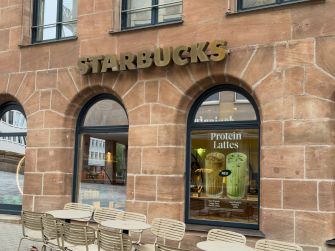
Starbucks is facing a proposed class action accusing it of calling protein drinks “Sugar-Free” even though some venti servings contain as much as 21 grams of sugar, setting up a fight over whether the label describes the syrup or the finished beverage.
Three consumers filed the lawsuit on October 2, 2026, in federal court in Seattle, challenging the names of Starbucks’ Sugar-Free Protein Lattes and Protein Matchas. A venti Sugar-Free Caramel Protein Matcha is listed with 21 grams of sugar, nearly as much as two Reese’s Peanut Butter Cups.
The lawsuit targets hot and iced versions of the Sugar-Free Vanilla Protein Latte, Sugar-Free Caramel Protein Latte, Sugar-Free Vanilla Protein Matcha and Sugar-Free Caramel Protein Matcha.
Why ‘Sugar-Free’ and ‘No Added Sugar’ Are Legally Different
The lawsuit’s core theory is that Starbucks used “sugar-free” as part of the name of the finished drinks, not simply to describe the flavored syrups. Under federal food-labeling rules, “sugar-free” is a regulated nutrient-content claim tied to the amount of sugar in the product itself, while “no added sugar” addresses whether sugar was added during preparation.
FDA regulations generally allow a food or beverage to use a sugar-free claim only when it contains less than 0.5 grams of sugar per reference amount and labeled serving. The complaint says a 12-ounce serving is the relevant measure for the Starbucks drinks.
That federal threshold supplies the benchmark for the plaintiffs’ false-advertising theory. They allege the protein-boosted milk causes the finished beverages to exceed the limit because lactose counts as sugar, even though the flavored syrups themselves add none. In their view, a drink can contain sugar-free syrup and still fail the federal standard for being marketed as a sugar-free beverage.
The lawsuit raises a second federal labeling issue involving calories. When a product uses a sugar-free claim but does not otherwise qualify as a low- or reduced-calorie food, federal rules can require additional calorie-related disclosures. The plaintiffs allege Starbucks failed to provide the disclosures required for the challenged drinks.
Starbucks says the lawsuit has no merit. The company points to nutritional information available through its menus, website and app showing the drinks’ total sugar content and says the sugar comes naturally from lactose in its protein-boosted milk. Starbucks also says its flavored syrups add no sugar and currently describes the protein drinks as having no added sugar.
The case therefore also raises whether those nutritional disclosures are enough to address any confusion created by the drink names. The plaintiffs argue that customers could reasonably understand “Sugar-Free” as describing the beverage they are ordering, while Starbucks points to information showing where the sugar comes from and how much the finished drink contains.
Starbucks introduced its protein-boosted milk and expanded protein lineup in September 2025 as the company added more high-protein options to its drink menu.
The three plaintiffs bought the challenged drinks in California, New York and Washington. Their lawsuit brings consumer protection lawConsumer protection law is the body of federal and state laws designed to protect people from unfair, deceptive, fraudulent, or abusive practices in the marketplace. These laws regulate areas such as advertising, sales, lending, debt collection, credit reporting, warranties, financial services, and consumer products.Read more → and false-advertising claims under the laws of those states and seeks to represent other customers across the country.
The proposed class action seeks damages, restitution, and a court order barring Starbucks from using sugar-free claims on drinks that allegedly fail to meet the federal standard.
The case is Walsh v. Starbucks Corporation in the U.S. District Court for the Western District of Washington.
Share This Article
If you found this article insightful, consider sharing it with your network.
Xiolene is a contributing journalist with more than a decade of experience in management, operations, and client service. Her background spans the veterinary and beauty industries, giving her experience working with businesses, consumers, employees, and service-focused organizations. Xiolene brings a practical business and consumer perspective to her coverage, focusing on making complex news and current events clear and accessible to readers.
Chobani must face a proposed class action accusing the company of misleading consumers by marketing yogurt as sugar-free even though each serving allegedly contains four grams of allulose, a sweetener that a federal appeals court found qualifies as sugar under federal labeling rules.The 7th U.S. Circuit Court of Appeals in...
Read
More »
Starbucks employees in Illinois, Colorado, and California are accusing the company of violating labor laws by requiring them to pay for new clothing and footwear under a recently updated dress code. Class-action lawsuits were filed in Illinois and Colorado state courts, while workers in California submitted complaints to the Labor...
Read
More »
Trader Joe’s is facing a proposed class-action lawsuit alleging the grocery chain misled customers about the caffeine content of one of its store-brand coffee products.
The lawsuit was filed on behalf of four shoppers in California, Illinois, and New York, and centers on the company’s French Roast Low Acid whole-bean...
Read
More »
Chobani is facing a federal lawsuit from Danone US over claims that it manipulated serving sizes to overstate the protein content of 32-ounce Chobani 20G Protein Greek Yogurt tubs.The lawsuit, filed June 15 in the U.S. District Court for the Southern District of New York, alleges Chobani uses an inflated...
Read
More »
PepsiCo Inc. and Walmart Inc. are facing a proposed nationwide class action lawsuit alleging the companies coordinated prices for Pepsi-branded soft drinks, resulting in higher prices for consumers who purchased those products at retailers other than Walmart.
The lawsuit was filed Dec. 15 in the U.S. District Court for the...
Read
More »