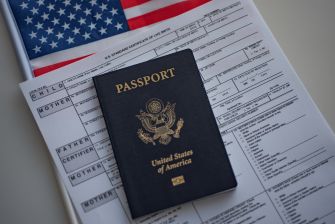
The Trump administration is proposing that parents applying for U.S. passports for their children provide proof of their own citizenship or immigration status, a new requirement tied to President Donald Trump’s latest effort to restrict birthright citizenship.
Draft State Department guidance would require parents or legal guardians to submit documents showing their status. U.S. citizens could provide a valid passport or birth certificate, while noncitizens could be asked for records such as an I-94 arrival document or permanent resident card. The proposed requirement has not been finalized.
The information would be used to determine whether a child is entitled to U.S. citizenship under an executive order Trump signed Aug. 6. Current State Department procedures already require parents or guardians to present valid identification when applying for a child’s passport, along with proof of the child’s U.S. citizenship and the parent-child relationship. The proposed guidance would go a step further by requiring parents to separately document their own citizenship or immigration status.
The proposal comes as the executive order behind the planned passport checks faces a federal court challenge.
U.S. District Judge Deborah Boardman in Maryland on Wednesday issued a preliminary injunctionA preliminary injunction is a temporary court order issued before a case is finally decided that requires a party to take or stop an action while the litigation continues. Federal courts generally consider the likelihood of success, irreparable harm, the balance of equities, and the public interest before granting one.Read more → barring federal agencies from enforcing the order against children covered by an existing class action challenging Trump’s birthright citizenship policies.
Boardman prohibited agencies including the State Department, Department of Homeland Security and Social Security Administration from denying or interfering with the citizenship of children covered by the case.
She allowed federal agencies to continue preparing guidance to implement the policy. The State Department can continue developing the proposed passport procedures while enforcement remains blocked for children protected by the injunction.
Trump’s Aug. 6 directive was issued after the Supreme Court rejected his broader attempt to restrict birthright citizenship in June.
The new order directs federal agencies not to recognize citizenship for certain U.S.-born children when neither parent is a U.S. citizen and a parent falls within specified categories. Those include some foreign government employees, people classified as alien enemies, and parents accused of fraud or commercial arrangements intended to obtain citizenship for a child.
The administration has described the policy in part as an effort to target “birth tourism,” in which foreign nationals travel to the United States to give birth so their children receive U.S. citizenship.
Trump’s previous order went further. It would have denied citizenship to children born in the United States when neither parent was a U.S. citizen or lawful permanent resident, and the mother was unlawfully or temporarily in the country.
The Supreme Court rejected that policy 6-3 in Trump v. Barbara on June 30, ruling that children born in the United States to undocumented immigrants and temporary visitors are citizens at birth under the Fourteenth Amendment.
Boardman cited that decision in blocking enforcement of Trump’s latest directive against the class of children before her court, finding that the Supreme Court had already established their citizenship.
Justice Department lawyers argued that the new challenge was premature because federal agencies had not yet published instructions explaining how the Aug. 6 order would be carried out. Boardman rejected that argument.
Trump’s directive gave agencies 30 days to issue public implementation guidance. The State Department has not announced a final parental documentation requirement, and its existing child passport requirements remain in effect.
Share This Article
If you found this article insightful, consider sharing it with your network.
Bridget studied Communications and Marketing at California State University, Long Beach. She also has experience in the live music events industry, which has allowed her to travel to festivals around the world. During this period, she acquired valuable expertise in branding, marketing, event planning, and public relations.
A federal judge in Maryland has blocked the Trump administration from applying President Donald Trump’s latest birthright citizenship order to a class of U.S.-born children, finding that the Supreme Court already settled their constitutional right to citizenship earlier this year.U.S. District Judge Deborah L. Boardman issued a preliminary injunction Wednesday,...
Read
More »
The Trump administration has paused immigrant visa appointments at U.S. embassies and consulates worldwide, days after a federal judge struck down a separate policy that blocked immigrant visas for nationals of 75 countries.The State Department says the scheduling changes are temporary and needed to train consular officers on how to...
Read
More »
President Donald Trump’s new order restricting birthright citizenship remained in effect Friday after a federal judge declined to immediately block it, while raising questions about whether the president can create new citizenship exceptions following a recent Supreme Court ruling.U.S. District Judge Deborah Boardman in Maryland denied immigrant-rights advocates’ request for...
Read
More »
A federal judge has struck down a Trump administration policy blocking immigrant visas for nationals of 75 countries, ruling that the State Department could not require otherwise eligible applicants to be denied based on nationality alone.U.S. District Judge Jeannette A. Vargas of the Southern District of New York issued the...
Read
More »
President Donald Trump signed two executive orders Thursday seeking to deny birthright citizenship to children in several defined groups and increase enforcement against foreign visitors who travel to the United States to give birth.The action marks a narrower attempt to limit citizenship at birth after the Supreme Court rejected Trump’s...
Read
More »
We use cookies and similar technologies to help our website function, understand how visitors use our site, and improve your experience. Some cookies are necessary for the website to operate, while others may be used for analytics or advertising.