We use cookies and similar technologies to help our website function, understand how visitors use our site, and improve your experience. Some cookies are necessary for the website to operate, while others may be used for analytics or advertising.
Viewing as a visitor in
Legal News, Information & Blogs
Trump Orders Federal Contractors to Notify White House Before Giving Congress Information
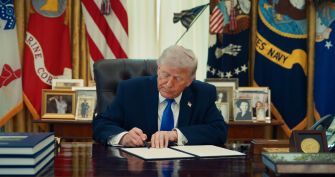
Photo Source: The White House, Public domain, via Wikimedia Commons
President Donald Trump has ordered federal contractors and subcontractors to notify the White House when Congress seeks information about their work or communications with the executive branch, setting up a potential separation-of-powers fight as Democrats prepare to take control of Congress in January.
The executive order, signed November 20, 2026, requires contractors to alert both the White House and the relevant federal agency about pending and future congressional requests. Contractors must also follow instructions to withhold communications that the White House or agency determines are protected by Executive PrivilegeA legal doctrine that can allow the president and the executive branch to keep certain confidential government communications from disclosure.Read more →. Companies that fail to comply could face contract termination, suspension, or DebarmentA government action excluding a person or company from receiving federal contracts or participating in certain federal programs for a specified period.Read more → from future federal work.
The order does not give the White House blanket authority to approve every piece of information a contractor provides to Congress. Its requirements apply to congressional requests involving the contractor’s communications or work with the executive branch, and the withholding provision specifically concerns information the administration determines is privileged.
Its practical effect could still be substantial. Federal contractors perform work across national security, defense, technology, health care, immigration and numerous other government programs, placing private companies in possession of information congressional committees may seek when investigating how federal agencies operate.
The order arrives weeks before Democrats assume control of both the House and Senate following the 2026 midterm elections and prepare investigations involving the Trump administration, federal contracts and other executive-branch activity.
The White House Says the Order Protects Executive Privilege
The administration says contractors sometimes receive confidential executive-branch information while performing government work and should not disclose it to Congress before the president can determine whether executive privilege applies.
The order describes executive privilege as a constitutional protection rooted in the Separation of PowersThe constitutional division of federal authority among Congress, the president and the courts to prevent one branch from exercising unchecked power.Read more → and argues that uncoordinated disclosures by contractors could undermine the confidentiality executive officials need to perform their duties.
It also frames the requirement as a government-contracting measure. The administration says contractors responding separately to congressional requests can create duplicative litigation, additional expense and uncertainty over sensitive information. Requiring coordination with the White House and contracting agencies, according to the order, will make federal procurement more economical and efficient.
Trump relies in part on the Federal Property and Administrative Services Act, a statute that gives presidents substantial authority to establish government-wide procurement policies tied to economy and efficiency.
Presidents from both parties have used that authority to impose conditions on companies doing business with the federal government. Courts have nevertheless examined whether particular contracting requirements maintain a sufficient connection to the statute’s procurement purposes and remain consistent with other federal laws.
That question could become important if the new order is challenged.
Congress Has Broad Power to Demand Information
The Constitution does not expressly give Congress an investigative power, but the Supreme Court has long treated the ability to obtain information as an essential part of the legislative function.
In Trump v. Mazars USA, the Supreme Court reiterated that Congress has broad authority to investigate matters connected to legislation and can issue subpoenas to obtain information needed to legislate effectively. The Court also made clear that the power has limits. A congressional inquiry must serve a valid legislative purpose and remain subject to constitutional protections.
Congressional committees routinely seek information from private companies as well as federal agencies. Contractors can become particularly important witnesses because they may possess records concerning how government programs were implemented, how federal money was spent or what communications occurred between private companies and executive officials.
A voluntary congressional request differs legally from a subpoena. Individual lawmakers and minority members may ask companies for information without possessing compulsory investigative power, while authorized committees can issue subpoenas that carry potential legal consequences for noncompliance.
The executive order applies broadly to “any pending or future congressional request” concerning a contractor’s work or communications with the executive branch, meaning its notification requirement is not limited to formal subpoenas.
A sharper constitutional dispute could arise if a congressional committee issues a valid subpoena and the White House directs a contractor to withhold responsive information.
Executive Privilege Is Powerful but Not Absolute
Executive privilege permits presidents to protect some confidential communications from disclosure, particularly communications involving presidential decision-making, national security and sensitive executive deliberations.
The privilege is not unlimited.
The Supreme Court has recognized constitutionally grounded presidential confidentiality interests while rejecting the idea that executive privilege creates an absolute shield against every demand for information. Congressional and executive officials have traditionally been expected to attempt to accommodate each branch’s legitimate interests before a dispute reaches the courts.
The Trump order takes the position that privilege can extend to certain communications shared with federal contractors. The Justice Department has previously argued that executive privilege can reach some communications involving people outside the formal executive branch when they participate in presidential deliberations.
How far that protection reaches when a private contractor receives a Congressional SubpoenaA legally authorized demand from a congressional committee requiring a person or organization to provide testimony, documents or other information.Read more → remains less settled.
A contractor may possess both genuinely privileged executive communications and ordinary business records concerning its federal work. Treating every document connected to government contracting as privileged would raise a substantially different legal issue from protecting particular confidential presidential communications.
The order itself does not declare every contractor communication privileged. It directs contractors to withhold material that the White House or contracting agency determines falls within executive privilege.
Contractors Could Face Competing Demands From Congress and the White House
The enforcement provisions place contractors in a potentially difficult position.
The order directs agencies to consider contract cancellation, termination, suspension or debarment when a contractor fails to comply. Those consequences could be significant for companies that depend heavily on federal business.
Congress has its own enforcement mechanisms. An authorized committee can issue subpoenas and may pursue contempt proceedings or civil enforcement when recipients refuse to comply. Congressional enforcement disputes involving the executive branch can become prolonged, particularly when privilege is asserted.
The conflict could become more complicated because federal law separately protects some contractor employees who disclose suspected government-contract misconduct to Congress.
Under 41 U.S.C. § 4712, many federal contractor and subcontractor employees cannot be fired, demoted or otherwise retaliated against for reporting information they reasonably believe shows gross mismanagement, waste, abuse of authority, threats to public safety or violations of law related to a federal contract. Members of Congress and congressional committee representatives are specifically listed among the people who may receive protected disclosures.
The executive order does not repeal those protections and states that it must be implemented consistently with existing law. The whistleblower statute also does not create a general right to disclose classified information.
The distinction could become important if the administration attempts to penalize a contractor because an individual employee independently provides Congress with information protected by federal whistleblower law.
The Fight Could Shift to the Courts Once Congress Begins Issuing Subpoenas
No court has yet ruled on the legality of the November 20 order.
A lawsuit filed before a concrete dispute emerges could face threshold questions about who has standing to challenge the policy and whether the disagreement is sufficiently developed for judicial review. A contractor facing termination for complying with a congressional subpoena would present a much more specific conflict.
The political timing makes such a confrontation increasingly plausible.
Democratic congressional leaders are preparing investigations after winning control of both chambers, and House Oversight Committee leader-designate Robert Garcia has already directed Trump allies, former administration officials and members of the president’s family to preserve records potentially relevant to future inquiries.
The White House has separately tightened controls over executive-branch employees communicating with Congress. The new contractor order extends that strategy beyond federal agencies and into the large private-sector workforce that performs government functions.
Any eventual court case could require judges to balance several established principles: Congress has broad authority to investigate in aid of legislation, presidents possess legitimate confidentiality interests, executive privilege is not absolute, and presidential contracting authority must remain grounded in powers granted by Congress.
The immediate effect of Trump’s order is simpler. Federal contractors receiving congressional requests concerning their government work must now bring the White House into the process before responding and risk losing federal business if they disregard administration instructions concerning privileged material.
Whether the president can use federal contracting power to enforce those restrictions when Congress demands the same information under its own constitutional authority may become the more consequential question.
Share This Article
If you found this article insightful, consider sharing it with your network.
Lawrence is an attorney and CEO of Law Commentary. Lawrence draws on his legal and business experience to help make court decisions, litigation, legislation, public policy, and other legal developments more accessible to the general public and to give readers clear context for understanding the law and how it affects businesses, consumers, and communities.
The White House has ordered federal agencies to obtain approval before employees agree to testify before Congress, giving President Donald Trump's legal and legislative affairs teams control over requests for testimony as Democrats prepare to investigate his administration after taking control of both chambers in January.White House counsel Will Scharf...
Read
More about White House Orders Federal Agencies to Get Approval Before Testifying to Congress »
White House Chief of Staff Stephen Miller has ordered administration employees to obtain advance approval from White House lawyers before meeting with registered lobbyists to discuss government policy, tightening access to President Donald Trump's administration days after taking over the West Wing.The directive, disclosed on November 13, 2026, prohibits staff...
Read
More about Stephen Miller Orders White House Staff to Get Approval for Lobbyist Meetings »
CNN, MS NOW and Politico expanded their lawsuit against President Donald Trump on Wednesday, accusing the White House of continuing to exclude their journalists from presidential events despite a federal judge's order restoring their press credentials.In an amended complaint filed October 28, 2026, the three news organizations asked a federal...
Read
More about CNN, MS NOW and Politico Expand Lawsuit Against Trump Over White House Press Ban »
President Donald Trump has escalated the U.S. trade fight with Canada beyond tariffs, ordering outright bans on imports of certain Canadian alcohol, dairy products and motorcycles beginning September 29.The move raises a legal question that became more important after the Supreme Court curtailed Trump’s tariff authority earlier this year. If...
Read
More about Trump Is Now Banning Canadian Imports—What Law Gives a President That Power? »
A federal judge has blocked the Trump administration from continuing to use an essay question that asked applicants for career federal jobs to explain how they would advance President Donald Trump’s policies and executive orders.U.S. District Judge George A. O’Toole Jr. in Boston issued a preliminary injunction Friday, September 11,...
Read
More about Judge Blocks Trump Administration’s “Loyalty Question” for Federal Job Applicants »