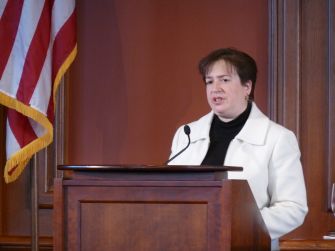
Supreme Court Justice Elena Kagan accused her conservative colleagues of damaging American democracy through rulings on voting rights, congressional redistricting and campaign spending, warning that their decisions have deepened political divisions ahead of the November 3 midterm elections.
Speaking at the Catholic University of America's law school in Washington, D.C., on October 20, 2026, Kagan criticized the court's majority for decisions she said have weakened electoral protections and given political parties greater power to influence election outcomes.
"The court has kind of blinded itself to the very deleterious effect of their rulings on how the political system works and has created a democracy that does not work as well as it should," she told students and professors.
Her criticism comes as states redraw congressional districts and political committees pour millions of additional dollars into campaigns under rules shaped by recent Supreme Court decisions. Kagan, one of three liberal justices on the nine-member court, dissented in several of the cases she singled out.
Among them was Louisiana v. Callais, an April 29 decision that narrowed how the Voting Rights Act can justify drawing congressional districts based on race. In a 6-3 ruling, the conservative majority found that Louisiana's creation of a second majority-Black district amounted to unconstitutional racial gerrymandering.
Writing for the majority, Justice Samuel Alito concluded that the Voting Rights Act did not require Louisiana to establish the additional district, leaving the state without sufficient constitutional justification for using race in its design.
Kagan, joined by Justices Sonia Sotomayor and Ketanji Brown Jackson, dissented, arguing that the decision weakened protections intended to prevent minority voters from being denied an equal opportunity to elect representatives of their choice.
The ruling has heightened scrutiny of congressional maps across the South, where disputes over minority representation could affect how districts are drawn in future elections.
Another major flashpoint is partisan gerrymandering, a practice that allows lawmakers to draw electoral boundaries in ways that favor their political party. The Supreme Court's 2019 ruling in Rucho v. Common Cause placed claims of excessive partisan gerrymandering beyond federal court review, leaving state courts and political institutions to address those disputes.
The conservative majority concluded that federal judges lacked manageable constitutional standards for deciding when partisan considerations in redistricting go too far.
That decision has gained renewed significance as Republicans and Democrats battle over congressional maps before the midterms. Texas and California have become prominent battlegrounds in efforts to redraw districts and gain additional seats in the House of Representatives.
"Over the last couple of years especially, both political parties have been engaged in a race to the bottom in terms of doing these partisan gerrymanders," Kagan said.
She argued that increasingly partisan districts push candidates toward more extreme positions, as primary elections become more influential in determining who wins a congressional seat.
The financial stakes have also escalated following the Supreme Court's June 30 ruling in National Republican Senatorial Committee v. Federal Election Commission, which struck down federal limits on political parties' coordinated spending with candidates.
Republican committees spent more than $137 million in coordinated expenditures between July and September, exceeding the former limits by approximately $126 million, according to federal filings analyzed by Reuters. Democratic committees spent about $55 million, surpassing the previous caps by roughly $46 million.
The 6-3 ruling found that restrictions on coordinated party expenditures violated the First Amendment's protection of political speech. Writing for the majority, Justice Brett Kavanaugh concluded that the limits imposed an unjustified burden on political expression, pointing to other safeguards against corruption.
Kagan dissented, arguing that the restrictions helped prevent wealthy donors from circumventing campaign contribution limits by channeling money through political parties to benefit individual candidates.
"The people of America look around and think that all this money chasing all these political candidates is a nightmare, and they're right," she said.
While sharply criticizing the majority's election-related rulings, Kagan also acknowledged decisions in which conservative justices have ruled against positions advanced by President Donald Trump's administration, including disputes over tariffs, birthright citizenship and mail-in voting.
With the November 3 elections approaching, the court's decisions are already affecting the political landscape. States are navigating new limits on race-conscious districting, partisan map challenges face restrictions in federal court, and political committees are spending substantially more money in coordination with candidates following the removal of federal caps.